

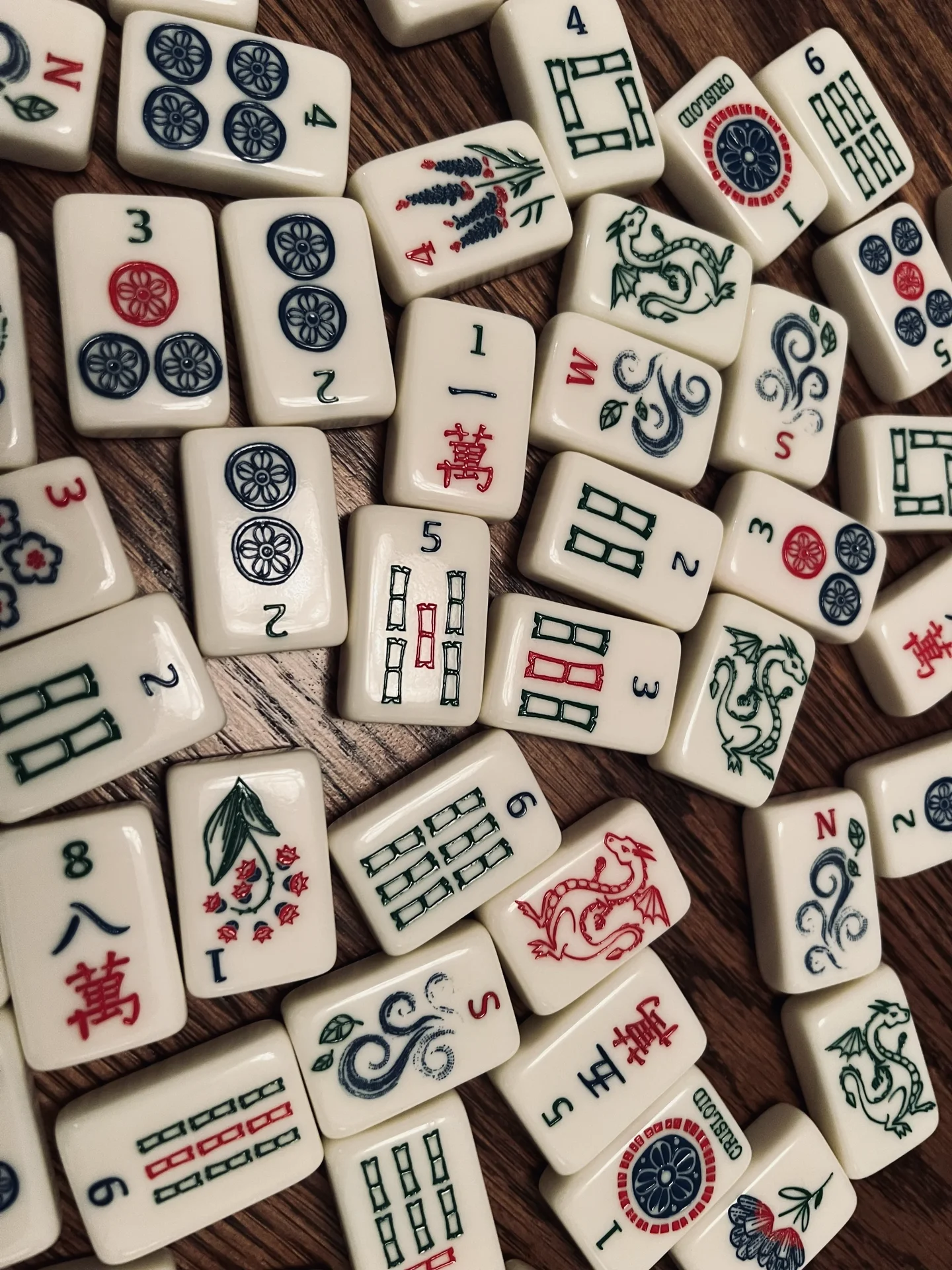
American mahjong is played with 152 tiles. Knowing the tiles is the first step to playing mahjong.
There are 3 suits in mahjong tiles: Bams, Craks, and Dots (shown below). If you are playing with a traditional set, these suits my vary slightly but should all look very similar to the examples below.
Each suit has tiles in numbers 1 through 9, and there are four of each tile. So for example, there are four 1 Dots, four 2 Dots, four 3 Dots, four 4 Dots, four 5 Dots, etc. all the way up to 9. There are four 1 Craks, four 2 Craks, four 3 Craks, etc. There are four 6 Dots, four 7 Dots, four 8 Dots, etc. There are a total of 108 number tiles.
Bams - Bams are usually green and look like bamboo. The 1 Bam is always a bird.
Craks - Craks are the traditional Chinese characters.
Dots - Dots are typically round dots and often have a floral vibe.
Each suit also has a matching dragon tile, and there are 4 of each.
The green dragon matches with Bams - players often remember that bamboo is green
The red dragon matches with Craks - a trick for this is to think that fire crackles and fire is red
The white dragon matches with Dots - the white dragon is usually referred to as Soap because the graphic looks like a bar of soap
There are four red dragons, four green dragons, and four soaps, for a total of 12 Dragons.
There are also four wind tiles, each with four tiles per wind.
North - N
South - S
East - E
West - W
Often there will be several hands on the National Mah Jongg League card with hands using a single tile of all four winds. It will appear on the card as NEWS, and players often refer to them as "news hands."
Set designs vary, but in most sets the winds will be indicated by letter. There are four N, four S, four E, and four W, for a total of 16 Wind tiles.
All tiles have 4 copies in a complete set except for Flowers and Jokers, of which there are 8 each.
Flower tiles vary greatly in their design. A traditional set might include a plum blossom, orchid, chrysanthemum, and bamboo design, but you should familiarize yourself with what the Flowers in your set look like before playing.
In some sets the flowers have numbers or season abbreviations on them. These don't have a meaning in American mahjong. All flower tiles are the same. You do not have to match up the Flower designs or any numbers. A Flower is a Flower no matter what it looks like.
Here are some examples of Flowers.
American mahjong is played with 8 Flowers. If your set has extra please remove them for gameplay.
The 1 Bam tile (of which there are four in every set) is always represented by a bird, but the designs vary widely. Because of their unique design, they are often confused with Flowers. The 1 Bam will always have a bird on it, even if the bird is very obscure. It is important to familiarize yourself with the Flowers and the 1 Bam in whatever set you play with. It is very common to think you have a Flower when in fact it is a 1 Bam.
Jokers are the other tile, in addition to Flowers, that have eight tiles in the set. Jokers are wild cards that can represent any tiles, however there are rules around when they can be used. It is important to know that although they can represent any of the tiles in the set they cannot be used in every circumstance. For example, they cannot be used in a hand for a single tile or a pair of tiles. These rules will be fully explained later.
Often in vintage and older sets the Joker is a red sticker or a tile with red nail polish over it because there were not eight Jokers available in traditional sets. This means that even within one set, the Jokers might look different from each other. Familiarize yourself with the Jokers in the set each time you play, in addition to the Flowers and the 1 Bam.
American mahjong is played with 8 Jokers. If your set has extra, please remove them for gameplay.
To play American mahjong, you will need a complete set of tiles, 4 racks, 2 dice, and your American Mah Jongg League Card.
A wide variety of accessories are also available to improve your gameplay experience. Many people like to use pushers to help move the walls to the middle of the table, shufflers to mix up the tiles before each game, and a play mat to protect the table and tiles. Have fun with it and make your game your own unique experience!
Many sets will come with blank tiles or extra Flowers and Jokers. These can be used for other types of mahjong. For American mahjong you will use:
108 Numeral Tiles
12 Dragons
16 Winds
8 Flowers
8 Jokers
Total: 152 tiles per complete set
American mahjong is played with 152 tiles. Knowing the tiles is the first step to playing mahjong.
There are 3 suits in mahjong tiles: Bams, Craks, and Dots (shown below). If you are playing with a traditional set, these suits my vary slightly but should all look very similar to the examples below.
Each suit has tiles in numbers 1 through 9, and there are four of each tile. So for example, there are four 1 Dots, four 2 Dots, four 3 Dots, four 4 Dots, four 5 Dots, etc. all the way up to 9. There are four 1 Craks, four 2 Craks, four 3 Craks, etc. There are four 6 Dots, four 7 Dots, four 8 Dots, etc. There are a total of 108 number tiles.
Bams - Bams are usually green and look like bamboo. The 1 Bam is always a bird.
Craks - Craks are the traditional Chinese characters.
Dots - Dots are typically round dots and often have a floral vibe.
Each suit also has a matching dragon tile, and there are 4 of each.
The green dragon matches with Bams - players often remember that bamboo is green
The red dragon matches with Craks - a trick for this is to think that fire crackles and fire is red
The white dragon matches with Dots - the white dragon is usually referred to as Soap because the graphic looks like a bar of soap
There are four red dragons, four green dragons, and four soaps, for a total of 12 Dragons.
There are also four wind tiles, each with four tiles per wind.
North - N
South - S
East - E
West - W
Often there will be several hands on the National Mah Jongg League card with hands using a single tile of all four winds. It will appear on the card as NEWS, and players often refer to them as "news hands."
Set designs vary, but in most sets the winds will be indicated by letter. There are four N, four S, four E, and four W, for a total of 16 Wind tiles.
All tiles have 4 copies in a complete set except for Flowers and Jokers, of which there are 8 each.
Flower tiles vary greatly in their design. A traditional set might include a plum blossom, orchid, chrysanthemum, and bamboo design, but you should familiarize yourself with what the Flowers in your set look like before playing.
In some sets the flowers have numbers or season abbreviations on them. These don't have a meaning in American mahjong. All flower tiles are the same. You do not have to match up the Flower designs or any numbers. A Flower is a Flower no matter what it looks like.
Here are some examples of Flowers.
American mahjong is played with 8 Flowers. If your set has extra please remove them for gameplay.
The 1 Bam tile (of which there are four in every set) is always represented by a bird, but the designs vary widely. Because of their unique design, they are often confused with Flowers. The 1 Bam will always have a bird on it, even if the bird is very obscure. It is important to familiarize yourself with the Flowers and the 1 Bam in whatever set you play with. It is very common to think you have a Flower when in fact it is a 1 Bam.
Jokers are the other tile, in addition to Flowers, that have eight tiles in the set. Jokers are wild cards that can represent any tiles, however there are rules around when they can be used. It is important to know that although they can represent any of the tiles in the set they cannot be used in every circumstance. For example, they cannot be used in a hand for a single tile or a pair of tiles. These rules will be fully explained later.
Often in vintage and older sets the Joker is a red sticker or a tile with red nail polish over it because there were not eight Jokers available in traditional sets. This means that even within one set, the Jokers might look different from each other. Familiarize yourself with the Jokers in the set each time you play, in addition to the Flowers and the 1 Bam.
American mahjong is played with 8 Jokers. If your set has extra, please remove them for gameplay.
To play American mahjong, you will need a complete set of tiles, 4 racks, 2 dice, and your American Mah Jongg League Card.
A wide variety of accessories are also available to improve your gameplay experience. Many people like to use pushers to help move the walls to the middle of the table, shufflers to mix up the tiles before each game, and a play mat to protect the table and tiles. Have fun with it and make your game your own unique experience!
Many sets will come with blank tiles or extra Flowers and Jokers. These can be used for other types of mahjong. For American mahjong you will use:
108 Numeral Tiles
12 Dragons
16 Winds
8 Flowers
8 Jokers
Total: 152 tiles per complete set
© 2026 We Mahj LLC | www.wemahj.com
The goal of Mahjong and the way to win and declare Mahjong is by creating one line of the American Mah Jongg League card (one hand) with the tiles on your rack. Therefore knowing the card is extremely important to your gameplay.
Please note: getting to know the card as a new player can be very overwhelming. You are about to get a ton of information below, and it might not make sense right away. It's ok. The learning curve is steep, but you will get there. We will have some tips and tricks for getting to know the card at the end. Don't get frustrated if this section seems confusing or overwhelming. Once you get the hang of the card, the game becomes much easier. And again, we will have lots of advice and tips for you to help ease you into it.
Each year the National Mah Jongg League (NMJL) publishes a new card. The card is usually released in March or April and can be ordered directly from their site. Often teachers also sell the official card. Do not buy the card from Amazon or photocopy it from a friend. The card is copyright protected.
Because there is a new card every year, the game stays fresh for new players and veteran players alike. Although other companies may have proprietary cards and many people have cards from previous years, once the new card comes out, most American mahjong players will play with the NMJL current card, and you can assume if you are playing in a game or tournament and no one has said otherwise that this is the card you will use.
Please note: In the explanations in this section we will show you sample hands. We made these hands up. They do not refer to any specific card from the NMJL. They are for learning purposes only. This ensures that this tutorial can be used year after year. We will have a separate section and lots of content for tips and tricks for the current card.
Each hand on the NMJL card contains 14 tiles. To win you must have 14 tiles on your rack that match the tiles on the card. Note that gameplay is with 13 tiles, and so mahjong is declared with the tile that you have picked up from a wall or the board to complete the hand. Much more explanation on that is below.
First let's review the symbols on the card. Each character represents one tile
F - flower
Numeral 1-9 - the number shown
D - Dragon
N- North
S- South
E- East
W - West
0 - White dragon/soap: Please note that when shown as a 0, the white dragon/soap has no suit. In other words it is not matched with Dots. It can be used with any suit, Dots, Bams, or Craks. More on this will be explained later.
X - Exposed hand. You may call tiles from the table and expose them on your rack for this hand.
C - Concealed hand. You may not pick up tiles from the table and expose them on your rack for this hand. You must make this hand with all tiles that you pick, which may include Jokers where appropriate.
Next, let's review the colors on the card. The colors represent different suits but they do not correspond to the three suits in particular. The colors tell you how many suits that particular hand needs but not what the suits have to be. This means that just because something is written in green, it does not mean that those tiles must be Bams. The three colors are simply used to show you when something needs to be the same suit or a different suit. Again, the colors do not correspond to particular suits.
Flowers are always printed in blue. There is no suit to a Flower. Winds are also printed in blue and are not associated with a suit.
If the numbers and/or letters are printed all in blue, that means that hand must be in all one suit. It could be all Bams, all Craks, or all Dots, but it must be all in the same suit. If you see something written in all blue with Flower symbols just remember that the Flower has no suit. It can be matched with Craks, Bams, or Dots.
If numbers and/or letters are printed in two colors then that means there are two suits in that hand, and if there are three colors it means there are three suits. Again it is not telling you which suits they must be, just that they must be either the same or different.
For example, if the hand reads:
11 22 333 4444 555
For this hand you will need consecutive numbers all in the same suit. It could be Bams, Craks, or Dots, whichever one you choose. It could look like any of the three hands below.
If the hand reads:
FF 11 22 3333 4444
For this hand you will need two Flowers, two consecutive numbers in one suit, and then the next two consecutive numbers in a second suit. This does not mean that the 1 and 2 tiles have to be Bams. There is no correlation between the color on the card and a particular suit.
Below are three examples of valid variations of this hand, but there are more. Notice how the colors on the card do not match the suits of the tiles. All hands have numbers in 2 suits, as shown by the green and red color.
If the hand reads:
FFFF 111 222 3333
For this hand you will need four Flowers, three consecutive numbers in one suit, the next consecutive number in a second suit, and then the next consecutive number in the third suit.
Below are 3 of the many valid variations of this hand. Again, note that the colors show that this hand must contain all three suits, but it doesn't indicate which order the suits must be.
There are also some terms that will be helpful to know:
Pung - a set of three like tiles (same number, same suit)
Kong - a set of four like tiles (same number, same suit)
Quint - a set of five like tiles (same number, same suit*)
Chow - a set of three consecutive numbers in the same suit
* For quints, since there are only four of each number, you must use a joker to represent one of the five numbers. This will be explained in more detail later.
The card is broken down into categories to help you identify patterns. Many categories are the same from year to year, although the hands within them change. Some hands are more straightforward and some hands are trickier. Categories often include Consecutive Numbers, Any Like Numbers, Winds and Dragons, 2468, 369, 13579, Singles and Pairs, and Quints. A new player might choose to focus on only one category at first so as not to get overwhelmed.
The card will illustrate exactly what you need to make that hand, and then there is an explanation in the parentheses afterwards of any additional information about options for that hand.
For example, the card might show
11 22 333 444 5555 (these numbers only, all one suit)
OR
11 22 333 444 5555 (any five consecutive numbers, all one suit)
Reading the information in the parenthesis becomes important because in the first example, you can use any of the three suits but only numbers 1 through 5, but in the second example you can use any of the three suits and also any five consecutive numbers, as long as they are in that pattern.
The numbers to the right of the hand indicate how many points that hand is worth if you are keeping score or betting. The X or the C indicate whether it is a concealed or exposed hand. Reminder, concealed means that you may not pick up and expose any tiles from another player to build your hand. You may only pick from the wall for concealed hands, unless the tile you need is to declare mahjong. X means that you can pick up tiles that another player has thrown and expose them on your rack.
Let's look at some specific examples to illustrate all of the above rules. This is a lot of information to absorb the first time, so do not get overwhelmed. You can go back and reread as many times as you need, and looking at examples will make things much clearer. Feel free to read examples below, but video tutorials might also be very helpful. Also remember that these are sample hands that we made up for learning purposes. There are sections dedicated to this year's card when you feel ready for that.
Example 1
11 22 333 444 5555 OR 55 66 777 888 9999 (one suit, these numbers only)
This is a common first hand in the consecutive run category, but every year the exact pattern of tiles changes. For this hand you can see that it is all in blue so all tiles must be the same suit. In the additional instructions, you can see that they must be the numbers shown only. The OR tells you that you can do the hand with either numbers 1 through 5 OR 5 through 9.
Example 2
11 22 333 444 5555 (any five consecutive numbers, all one suit)
This hand may look similar to the one above, but the additional information tells a very different story. For this hand you still need consecutive numbers in a certain pattern and all in one suit, but it can be any five consecutive numbers. It doesn’t have to be 1 through 5.
Please note: When mahjong players talk about the hands, they will often use numbers to refer to the quantity of tiles that form that particular pattern in the hand. In example 2, a player might describe what they are collecting as “consecutive numbers two-two-three-three-four.” They do not mean that they are collecting 2 Bams or 2 Dots per se. They mean they are collecting two identical tiles. Example 3 below might be described as “four-four-three-three in two different suits” because the quantity of consecutive numbers follow that pattern.
Example 3:
1111 2222 333 444 (any consecutive numbers, any 2 suits)
Here we see a hand that is made by collecting any four consecutive numbers in a four-four-three-three pattern in any two suits.
Example 4:
222 44 666 88 DDDD (these numbers only with matching Dragons)
For this hand you would need even numbers all in the same suit in a three-two-three-two pattern with four matching Dragons. Remember that each Dragon matches with a suit - Red with Craks, Green with Bams, Soap with Dots.
Example 5:
22 44 66 88 DDD DDD (even numbers with opposite Dragons)
In this hand, you would collect two tiles of the even numbers in the same suit and then Pungs of opposite Dragons. Remember that a Pung is a group of three identical tiles. So for this hand, if your numbers were Dots, then you would collect the Green and Red Dragons. If your numbers were Bams then you would collect Red Dragons and Soaps. If your numbers were Craks then your Dragons would be Greens and Soaps.
© 2026 We Mahj LLC | www.wemahj.com
Now that you know the tiles let's talk about how to set up the game and deal the tiles.
American Mahjong is played with four players and your complete set of 152 tiles. Each player sits at one side of a square table. Each player should have a rack in front of them to hold their tiles.
Helpful Tip: You can determine which side of the table belongs to which player by using compass directions, designating the seats around the table as North, South, East and West. The East is usually assigned to an experienced player, if one is present, or simply the player who rolls the highest number on the dice initially. You can also choose the East at random or decide among yourselves which player will begin in that spot. From then on you can rotate who starts. It is the same for all four players, and many people have their own superstitions and preferences about which seat is the luckiest.
All tiles are placed face down in the middle of the table and mixed. Many people mix the tiles in a circular motion, enjoying the distinct sound of the tiles scraping against one another. Often called "the splash," this process is fun and ritualistic, and many people consider it almost meditative. If you are new to the game just have fun mixing the tiles all around in the middle of the table. In more advanced games people might use an automated shuffler. If this is the case, then just follow the shuffler's instructions and load the correct number of tiles into it.
The wall is a stack of face down tiles, placed two high, that each player makes using 38 tiles. Each player should make a stack of tiles in front of their rack. The stack should be 19 tiles long and 2 tiles high.
Once each player has built their wall, the four walls are pushed to the center of the table using a push bar or your hands. After pushing the walls in, they should create a square in the center of the table. The walls need to be flush with one another to form a continuous unbroken loop of tiles. This is where we will draw tiles from as the game progresses.
Next, the East rolls the two dice. The total of the dice tell the East how many stacks of two to count starting at the right end of their wall. For example if the dice show 3 and 6 (totaling 9), the East should count from the right side of their wall, nine stacks over. After counting, the East will then pick up those two tiles (the 9th stack) and place them on top of the wall to the right of where they were picked up.
This is breaking the wall. Now there is a break in the wall where the two tiles that the East picked up used to be, and there are also two tiles sitting on top of the wall to the right of that break. These two tiles will be the last tiles to be used if a game goes all the way through every tile in the wall.
Now it's time to pick up tiles and start building a hand! All players pick their tiles from the wall starting from the break. The East picks first and picks from the two stacks to the left of the break.
For the first round of picking, the East picks four tiles (two stacks), then the next player to the right of the East picks four (moving to the left on the wall), then the next player to the right picks their four (again moving to the left on the wall), and finally the last player picks four. Remember: Game play moves to the right, but the wall moves to the left. That is why each player picks to the right of the East in turn, but the tiles on the wall are moving to the left.
This process of each player picking four tiles in turn repeats two more times so that every player has picked 12 tiles total. All tiles should be placed on the player's rack as they are picked.
In the course of dealing the East's wall will be used up (remember there is still a portion of the wall against the East's rack. Those are the last tiles to be played.) The player to the left of the East should push out their wall, hinging on the left and pushing out with the right hand. Pushing out the walls is the only movement that goes to the left (clockwise), and it is often a source of confusion for players.
When every player has 12 tiles, the East should then pick the first and the third top tiles on the stack. The next player to the right then takes the bottom tile from the next row, then the next player to the right takes the top tile in the next row, and finally the last player takes the bottom tile in the last row. All players now have 13 tiles, and the East has 14. There is one bottom tile left at the end of the wall.
Please Note: The East taking the first and third tiles is not as random as it might first seem. If the East took the first tile from the top and then all players took in turn, the East would end up taking the next tile, which is that third top tile. Taking them in one turn is more efficient.
Now it's time for the Charleston
© 2026 We Mahj LLC | www.wemahj.com
Before regular gameplay begins, there is a series of passes that players make in a particular order. This is called the Charleston. There are seven rounds to the Charleston. The first three are mandatory and the others are optional, although most of the time players play all seven rounds.
The passes go right, across, left, left, across, right and are explained in detail below. The passes and their rules are often a source of confusion or intimidation for new players. Some players use the acronym ROLLOR (right, over, left, left, over, right) to remember the order, and of course you can pass with confidence using our in-game Charleston coach to guide you through each step.
Remember that tiles have been dealt and all players have 13 (or 14 in the case of the East) tiles on their rack. The East has a slight advantage with an extra tile in play during the Charleston.
Please Note: Jokers may not be passed in the Charleston. All other tiles may be passed. There are many strategies and theories about which tiles are best to pass and which are best to keep, but in the beginning just focus on what you don't want for your possible hands.
Each player takes three tiles from their hand and passes them face down, to the person on their right. You must pass your tiles before you pick up and look at the ones that are passed to you. It is good practice to wait until everyone has passed before you pick yours up. You should still have 13 tiles (14 for East) on your rack.
Each player takes three tiles from their hand and passes to the person across from them. Again, tiles are passed face down and players should not pick up and look at tiles that are passed to them until they have passed tiles. There should never be more than 13 (or in the case of the East 14) tiles on your rack at one time.
Each player takes three tiles and passes to the player on their left. On this pass there is an opportunity for something called a blind pass, which you would use if you don't have three tiles on your rack that you want to pass. You might only want to get rid of two or one, or sometimes you don't have any you want to pass at this point.
In a blind pass you may take one, two, or all three of the tiles passed to you without looking at them and pass them directly to the person on your left. You still must pass three tiles, so if you have two tiles from your hand to pass then you will pass those two of your own tiles plus one that was given to you (face down and without looking at it; any of the three given to you). Then pick up the other two tiles that were passed to you and put them on your rack. If you have only one tile from your hand that you want to pass, then you take one from your rack plus two from the person who passed to you (face down and without looking at them). Put the other one tile that was passed to you on your rack. If you don't have any tiles you want to pass then pass over all three tiles that were passed to you (face down and without looking at them).
At this point the mandatory first round of the Charleston is complete. Any player has the opportunity to stop the Charleston at this point if they feel that their hand is strong enough and they don't want to pass more tiles. It is important that players do not move on to the next pass (second left) until they know that no one is stopping the Charleston.
If a player stops the Charleston, then you skip the second round (next three passes) and go right to the optional across pass (seventh pass).
If no one wants to stop the Charleston at this point then you move on to the second round (fourth pass).
Each player takes three tiles from their rack and passes them to the player on their left. It is common practice at this point to pass them in a stack of two on the bottom with one on the top to indicate that this is the second Charleston. Blind pass is not an option.
Each player takes three tiles and passes them in a stack to the person across from them. Blind pass is not an option.
Each player takes three tiles and passes them to the person on their right. This is another opportunity for a blind pass. If you do not have three tiles that you want to pass, you may take one, two, or three of the tiles that were passed to you and, without looking at them, first pass them directly to the person to your right, along with however many of your tiles are needed to pass three total. This is the same procedure outlined in detail above in the third pass.
The seventh and last step of the Charleston is the courtesy pass. Players across from each other may pass zero, one, two, or three tiles with each other. Those players must agree on how many tiles to pass; they must pass the same number of tiles. If somebody wants to pass three and somebody wants to pass two, they must negotiate for how many tiles they will actually pass. Some players might strategize at this point and say if you don't want to pass three then I don't want to pass any with you. Some players just want to exchange as many as they can. You will develop your own strategy with gameplay.
Please Note: The players across from each other must pass the same number of tiles, but both pairs of players do not have to. In other words, East and West players may pass two while North and South players pass three.
© 2026 We Mahj LLC | www.wemahj.com
Now that the Charleston is over the game can begin. Let's go over some basics first.
Since the East has 14 tiles they begin the game by discarding one tile without picking first. When the East has discarded, gameplay continues with each person picking and discarding a tile in turn to maintain 13 tiles on the rack at all times.
Please Note: When you discard a tile you should verbally name that tile as you throw. Make sure you are naming the tile correctly.
What does it mean to pick a tile? It means that either you are taking the next tile in line on the wall in the middle of the table OR you are calling for a tile that has been discarded by another player. Your turn begins when you pick up a tile either from the wall or from the table and then rack that tile, and your turn ends when you discard.
Gameplay moves to the right. This means that a player picks and discards, and then the next player to go is the person to their right.
Walls move to the left. This means that when a wall gets depleted, the person to the left of that wall pushes their wall out to the middle of the table, hinging on the left and pushing with the right hand, and turning the left stack of two tiles to indicate not to draw from that side.
These rules are often confused and forgotten. Gameplay moves to the right. Walls move to the left. At some point during the game, if it gets this far, the only wall that will remain is the section of the broken wall in front of the East. If all of those tiles have been used and no one has declared Mahjong then there is no winner and it is declared a wall game.
Getting back to the gameplay, the game begins with the East discarding their extra tile. After the East has discarded, the person to the right of the East picks and then discards, and so on around the table in a counterclockwise fashion (to the right). If at any time a tile is thrown that any player wants, they can call that tile by claiming it before the next player picks and racks the next tile from the wall. Calling a tile is explained in detail below. When a tile is called and then that player discards, gameplay continues to the right of that player (yes, this means your turn might be skipped).
The gameplay continues to the right with each player picking and discarding and building their hand until somebody declares Mahjong and is the winner or until there are no tiles left on any of the walls. This is called a wall game.
It does not have to be your turn in order to call a tile. If at any time someone throws a tile that you can take, then stop play to call the tile. This means that you will pick it up from the table and expose it on your rack and now it is your turn to discard to maintain 13 tiles. The next person to go is the person on your right.
Which tiles can you call? You may call a tile if it appears in a Pong, Kong, or Quint in your hand and you have the other tiles to complete the set. In other words, if the hand you are playing requires three, four, or five of the exact same tile (same number and suit) AND you have the rest of the numbers already on your rack, either alone or with a Joker, then you may pick up the tile and put it on the front of your rack, face up, for the other players to see.
Please Note: Quints by definition need at least one Joker since there are only 4 of each tile (except for the Flower).
For example, if the hand you are playing calls for three 2 Bams and you have two already and somebody throws a 2 Bam, you may call it and expose all three 2 Bams on the top of your rack.
If you need four 2 Bams for the hand you are trying for and you have two and somebody throws one you may NOT pick it up because it does not complete the set you need (you need four and this would only be three). Once you expose tiles you may not add or take away from them.
This rule trips some people up at first. Let's say it again. You pick up a tile from the board only if it completes a Pung, Kong, or Quint that you need for the hand that you are trying for on the Mahjong card and only if you have the tiles to complete the set. You may use Jokers to complete the set if you have them, but if you can't complete the Pung, Kong, or Quint that you need then you sadly have to let that tile go.
Another very important thing to remember is that you can only pick up tiles for a Pong, Kong, or Quint, meaning a set of three, four, or five. You cannot pick up a tile to complete a single or a pair, unless you are picking it up for Mahjong. Again, this is a rule that leads to a lot of confusion and mistakes in beginner players, so let's get some specific examples about what that means.
If you are trying to make the hand in the first 2468, you have two 2 Dots and you need three, somebody throws a 2 Dot you can call it and put all three 2 Dots on your rack exposed. If you have one 2 Dot and a Joker and somebody throws a 2 Dot you may take the 2 Dot with yours and the Joker and expose all three on your rack. If you are going for the second hand in 2468 and you need two Flowers and you have one and somebody throws a Flower you may not pick it up because you may not pick up a tile for a pair unless you already have the rest of the hand and you only need that Flower to make Mahjong. Let's look at Consecutive Run hand number 7, second from the bottom. That hand calls for 1 2 3 4 5 of one suit, four ones of another suit, and four ones of the third suit. It is any five consecutive numbers with a pair of any number in the run and matching Kongs. It's a pretty complicated hand for a beginner because there are many variations. We will talk about that hand in depth below, but for these purposes just know that you can use a Joker or call a one for the one Kongs. So when you are collecting four ones, however, for the 1 1 2 3 4 5 those are all single tiles and one pair of tiles and therefore you cannot use Jokers nor can you call them from the table unless it is for Mahjong. Even though they are all in a clump on the card and all written in green, that does not mean that they are a Kong or a Pung. Those are all individual tiles because they are not the same number. Therefore you cannot use Jokers nor can you call them from the table unless you have the rest of the hand and you only need that one tile to declare Mahjong.
There are some rules around Jokers.
You can't pass Jokers in the Charleston.
Once you have Jokers on your rack you may use them as any tile but you may NOT use them in a single or a pair ever. That means you can't use them as a single or a pair on your rack or to call a tile. They may only be used in Pungs, Kongs, or Quints.
Please Note: Sometimes a group of numbers or letters on the card might look like it's a Pung, Kong, or Quint when really it's just a collection of single numbers together. For example, people often think that NEWS is a set when really it is a group of single tiles and therefore cannot use a Joker. Similarly, a run of consecutive numbers even in the same suit is not a set and can't use a Joker. For a set to be a Pung, Kong, or Quint, the tiles must be identical in number/letter and suit.
You can discard a Joker if you don't need it, however you may never call a Joker from the table.
If somebody has a Joker exposed on their rack, you may replace that Joker with the tile that it is representing. You do this when it is your turn after you have picked (either from the wall or by calling a tile). You pick a tile to start your turn and then you hand the replacement tile to the appropriate player and ask for their Joker. They will make the exchange. It is considered bad etiquette to touch someone else's tiles. You may now put that Joker on your rack. It does not have to be exposed or used right away. It is now just another tile on your rack to use or throw as you see fit. End your turn by discarding a tile.
You may use Jokers for any Pung, Kong, or Quint. In fact a Quint by definition has to include at least one Joker since there are only four of each tile, with the exception of Flowers of course. But if you are collecting a Kong of 9 Dots, you may use Jokers for all four of those 9s if need be. Similarly, if someone throws a 9 Dot and you have three Jokers, you could call the 9 Dot with three of your Jokers.
If you are playing to keep score, then each hand is worth the numerical value of what is written to the right of that hand. That number represents the amount of points that you collect from each player. Most hands are worth 25 points, with trickier hands being worth more, concealed hands being worth more, and singles and pairs being worth more.
If you declare Mahjong by picking your own tile from the wall, then you score double from each player. If a hand is worth 25 points then you collect 50 from each player.
Please Note: Picking your own tile would include picking a Joker from the wall, but it also includes picking a tile that you can use to replace someone else's Joker from an exposure.
If you declare Mahjong by picking a tile thrown by another player then you collect double from that player only. If a hand is worth 25 then each player will give you 25, but the person who threw the tile will give you 50.
If you declare Mahjong with no Jokers then you score double from each player. If a hand is worth 25 then you would collect 50 from each player, if a hand is worth 30 points then you collect 60 from each player, etc.
If you declare Mahjong with no Jokers by picking your own tile, then the hand is worth times four for each player. A hand worth 25 points would collect 100 from each player.
If you declare Mahjong with no Jokers by picking up a tile from another player, then you collect double from each player but the player who threw the tile gives you four times the number.
If you are playing for money then the numbers represent cents (or perhaps dollars if it's really a high stakes table!).
You are now ready to play mahjong! Keep practicing and you will learn the card, develop your strategy, and have lots of fun!
© 2026 We Mahj LLC | www.wemahj.com